
Script compliance
Mandatory script items and completion rate per call and per item.
AI transcribes every conversation from your PBX, checks it against your scorecard and shows exactly where in the recording things went wrong. It works for voice bot calls and human agents alike.
Already a customer? Log in
Updated
Speech analytics is automatic AI transcription and scoring of phone conversations. The system turns every recording into text, checks it against your scorecard and flags goals met, caller sentiment and risky phrases. Managers see scores for 100% of calls with quotes from the conversation, not a small sample they had time to listen to.
Each call opens in a single view. The recording with a waveform and speaker colours sits next to the transcript and the AI score for each criterion. Every score is backed by a quote: click it and the player jumps to that second.
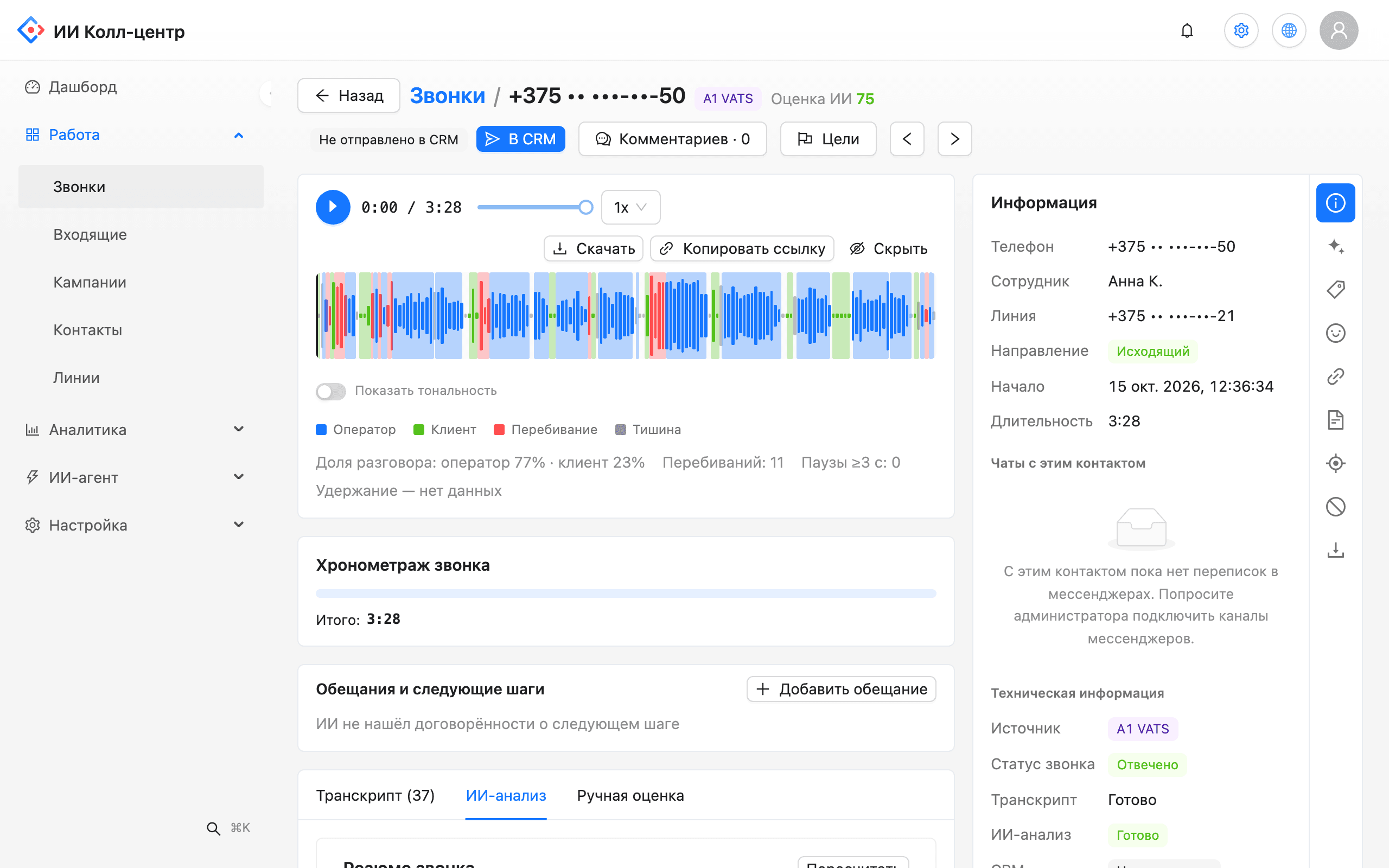
On the AI analysis tab every call has a short summary of a few sentences and a quality card with an overall score. The summary saves a manager's time: the gist of the conversation is visible before listening, and it goes to the CRM as a note with a link to the call. After a recalculation the summary is refreshed for the selected analysis scenario.
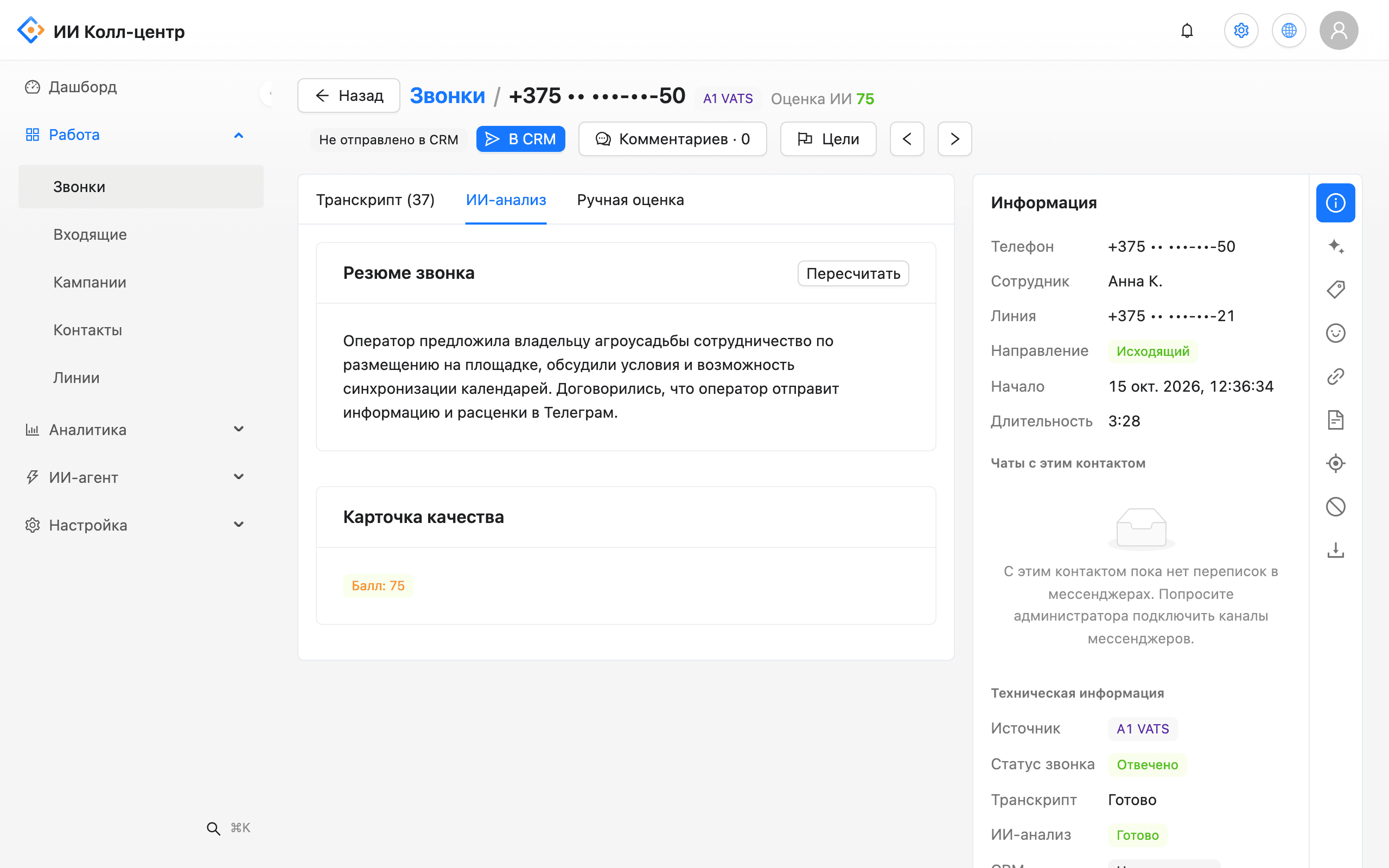
The dashboard rolls up every call in the period: how many conversations happened, the average score, which goals were met and where negative caller sentiment is growing. You set the alert rules yourself: metric, threshold and time window.
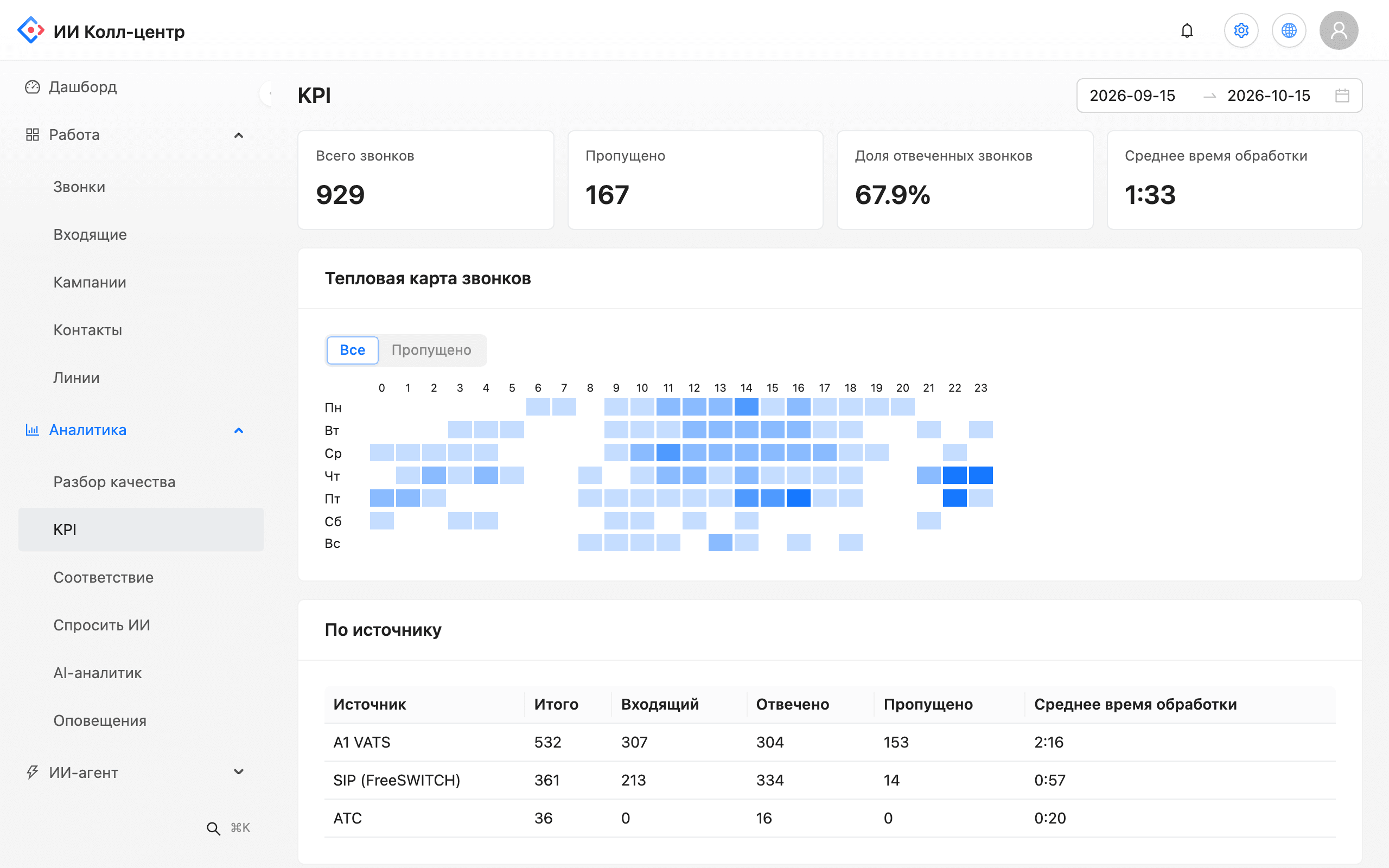
Instead of exporting to a spreadsheet, ask: “Why did callers cancel bookings last week?” The AI analyst reads calls from a period of up to 93 days and answers with links to specific conversations. Each conclusion shows how many calls it is based on.
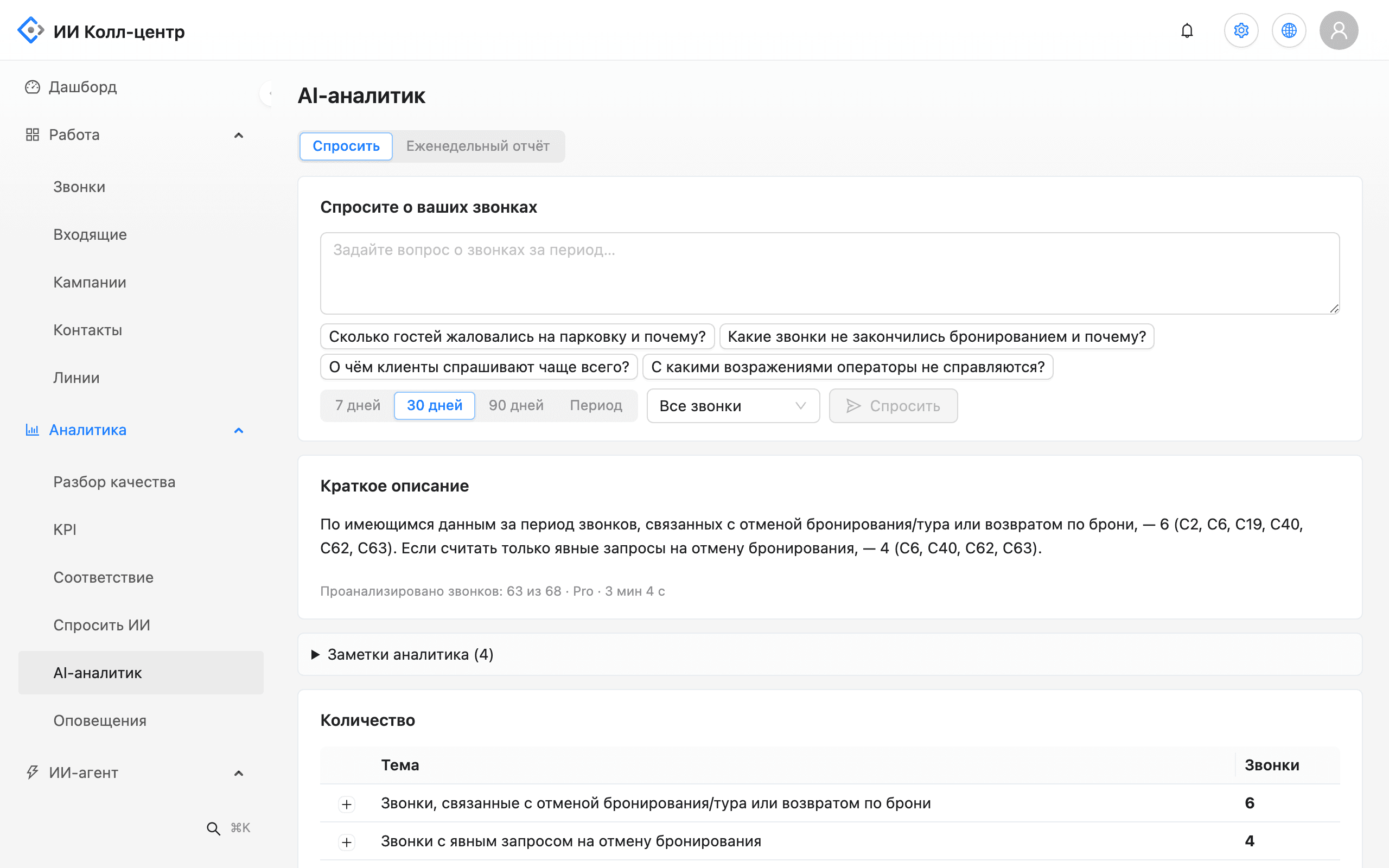
All speech analytics features work on one call base, so you do not need a separate tool for each job.
Mandatory script items and completion rate per call and per item.
Was there a booking, a sale or a resolution? The AI picks a goal set for the call type.
The AI finds “I'll call you back by 6 pm”, sets a due time and flags it when overdue.
Objections and blockers with quotes: handled, partly handled or not handled.
Low-scoring moments per criterion, with the reason and a link to the second.
Upload wav, mp3, ogg, m4a and webm files, or auto-import from a PBX folder.
Years of CRM and call history: loss reasons with exact counts and deal links, stalled deals with the last call and the promise made, reports by stage and manager. Premium, on the test stand.
Problem. The manager hears a few calls a week and cannot tell why the other deals fell through.
What the AI does. The AI scores every sales call against a sales scorecard and collects refusal reasons with quotes.
Outcome. Deal reviews rely on facts from recordings, not on the rep's retelling.
Problem. Missed bookings and wrong prices only surface after a complaint.
What the AI does. The booking goal and the accuracy criterion are checked on every call, and failures trigger an alert.
Outcome. The team learns about the issue the same day and can call back in time.
Problem. Every conversation needs an audit, and nobody can listen to the full volume.
What the AI does. Dual-channel recording, transcription and checks for tone and mandatory phrases on all calls.
Outcome. A disputed call is found by search in minutes, with the exact quote.
Problem. A mentor cannot see where exactly a new hire loses the customer.
What the AI does. The employee card and 360 report show weak criteria and the worst calls in the period.
Outcome. Coaching focuses on specific moments in recordings, not general advice.
A pilot starts with your real recordings. No PBX or number change is needed.
A1 VATS, your PBX over SIP, or recording uploads. History import covers older calls.
Start with the standard criteria (greeting, needs discovery, accurate information, objection handling, next step) and add your own.
Define what a successful call means and add product names, competitors and stop words.
Choose metrics and thresholds that send the manager a Telegram message.
A supervisor scores some calls by hand; the calibration screen shows gaps per criterion.
Managers usually hear only a small share of calls. AI scores every recorded conversation, so rare but important failures are not missed. Manual review stays: the supervisor sees their score next to the AI score.
Start with five base criteria and add items for your industry: quote the price, offer a booking, confirm the date. Each criterion gets a weight and the total is a weighted average. Our blog post on scorecards covers the details.
For Russian telephone speech the transcript is good enough for scoring and search, but names and numbers can contain errors. That is why every AI score comes with a quote and a link to the second, so a disputed moment is easy to replay.
On the test stand one minute of audio took about 16–22 seconds (RTF 0.27–0.37). This is an early measurement, not a guaranteed turnaround: speed depends on load and hardware.
No. Sentiment is measured for the caller only. The system never scores an employee's emotions from their voice; this is a deliberate product decision.
Yes. Analytics works on any recordings from your PBX, not only voice bot conversations. You can also upload older recordings as files.
Add stop words to the dictionary and an alert rule on negative caller sentiment. You can also ask the AI analyst in plain language and get links to specific calls.
No. New criteria apply to new calls, while scored conversations keep their original score. That keeps history comparable.
No. Calls and recordings come from A1 VATS, from your PBX over SIP, or as uploaded files. Your number and carrier stay the same, and a pilot can start from recordings you already have.
Phone numbers, emails and card numbers are masked before text is stored and before it is sent to a language model. Admins set retention for recordings and transcripts. For strict requirements there is an on-premise install.
In a pilot we show a report on your recordings: a scorecard, goals and alerts for your industry.